Zadar
23 places
The Zadar archipelago and its mainland heart form a single story told in stone, water and light. The Adriatic’s tides sculpt the coastline, Venetian forts guard ancient trade routes, and modern art turns waves into music and sunsets into power. Begin on the island of Ugljan, where limestone ridges meet pine woods and quiet coves, then cross the Zadar-Kanal to the city’s marble forums and Byzantine domes. Walk the promenade where sea organ pipes hum with every swell, stand beneath the glass sun that stores daylight for the night, and climb to Fort St Michael for a view of two hundred islands. This is a route where history is read in layers—Roman, Venetian, 21st-century—and where every footstep echoes with the voices of saints, sailors and stonecutters.
Island of Ugljan’s green spine
Ugljan rises from the Zadar-Kanal like a green spine, its north-eastern shore dotted with villages while the south-western cliffs drop sheer to the sea. The island’s 50 square kilometres hold seven settlements, from Ugljan village in the centre to Lukoran and Sutomišćica along the sheltered shore. A single bridge at Ždrelac links Ugljan to Pašman, yet the island keeps its own rhythm—olive groves and vineyards, the scent of pine resin, and bays such as Muline in the north-west and the paired Lamjana vela and Lamjana mala in the south-east. At the island’s heart stands Fort St Michael, a thirteenth-century Venetian watchtower built on foundations that may date to the sixth century. From its 265-metre summit the view stretches over the Zadar archipelago and the Kornati National Park, where the islands float like dark shards on the blue water.
Lukoran’s olive terraces and song
Lukoran clings to Ugljan’s north-western flank, a village of 503 souls whose livelihoods still turn on olives, wine and fish. Stone houses huddle beneath a canopy of Aleppo pines, and the shore is a necklace of small beaches and hidden coves. The de Ponte family mansion, a seventeenth-century stone villa, overlooks the bay, while the village claims the birthplace of Petar Preradović’s guardian song “Zora puca.” Paths wind through the pinewoods to lookouts over Zadar’s skyline, and in the evening the scent of woodsmoke mixes with the salt air drifting from the channel.
Ošljak, the tiny jewel
Ošljak is a speck of land just 300 metres from Ugljan’s western tip, measuring barely 0.3 square kilometres and home to 29 people. The island’s single settlement huddles beneath a 90-metre plateau called Lazaret, where the remains of a sixth-century church of St Mary stand against the wind. Once called Calugerà and owned by a noble Venetian family, Ošljak offers steep paths, sheer cliffs and a view that takes in Zadar’s waterfront and the distant Velebit mountains. Small boats anchor in the lee of the island, and the silence is broken only by the cry of gulls and the slap of waves against limestone.
Zadar’s Roman forum and medieval saints
The Roman Forum in Zadar’s old town occupies a 90-by-45-metre rectangle laid out in the first century AD under Augustus. Two towering columns still rise above the cobbles, and the stub of a third once served as a wash-place in the Middle Ages. Above the forum’s eastern edge stands the church of St Donatus, a ninth-century Byzantine rotunda built on the ruins of the forum itself. Its 26-metre interior, ringed by an upper gallery and a ground-floor ambulatory, still holds fragments of Roman columns and the foundations of an early medieval baptistery. Next door, the cathedral of St Anastasia, begun in the fourth century and expanded in the twelfth and thirteenth, shelters the relics of the city’s patron saint beneath a Romanesque façade of 1324.
St Chrysogonus and the queen’s secret
Beside the forum’s northern flank, the church of St Chrysogonus was consecrated in 1175 on the site of a Roman market. Its single nave preserves the memory of Queen Elizabeth of Bosnia, murdered in 1387 and secretly interred here for three years before her body was taken to Hungary. The church’s unfinished bell tower, begun in 1485 and abandoned in 1546, still leans against the sky, while inside the Romanesque rhythm of the walls frames the quiet glow of candlelight on ancient stone.
The sea organ’s wave song
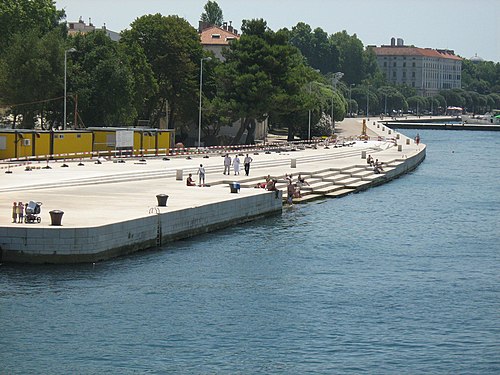
Where the Roman wall meets the waterfront, a flight of stone steps descends to the Meeresorgel, an instrument played by the Adriatic. Thirty-five pipes of differing lengths and diameters lie half-submerged beneath the promenade; as waves push water into the tubes, air vibrates into shifting melodies. The installation, opened in 2005 as part of the “nova riva” project, won the European Prize for Urban Public Space in 2006. Visitors sit on the steps, feet dangling above the pipes, while the organ’s ever-changing harmonies rise and fall with the tide.
The glass sun that never sets
A hundred metres along the quay, a circle of 300 photovoltaic glass plates, each two metres across, forms the Monument to the Sun. By day the plates absorb sunlight; after dusk they radiate stored energy into a choreographed light show that follows the sun’s path. Designed by Nikola Bašić, the installation also serves as a perpetual calendar, marking the feast days of local saints and the lengthening or shortening of daylight through the seasons. Beneath the main disc, smaller circles mark the planets to scale, creating a miniature solar system embedded in the harbour pavement.
Fort St Michael’s island eyrie
To reach Fort St Michael from Zadar, cross the Zadar-Kanal and follow the three-kilometre road that climbs Ugljan’s spine to 265 metres. The Venetian fortress, built in the thirteenth century on earlier foundations, once watched over the archipelago for approaching ships and invading armies. Inside the ruined walls, the remains of a fourteenth-century Gothic church and a Benedictine monastery hint at centuries of prayer and warfare. From the battlements the eye travels over two hundred islands of the Zadar archipelago and south to the jagged silhouette of the Kornati National Park, a landscape of limestone and pine where the sea is still the colour of lapis lazuli.
Poljana’s quiet bay and Romanesque church
On Ugljan’s eastern shore, the hamlet of Poljana sits in a shallow bay where the Zadar-Kanal laps against vegetable gardens and olive terraces. The village’s thirteenth-century church of St Peter, built of local limestone in simple Romanesque lines, overlooks the water from a low rise. Behind it, the land falls away to salt pans and reed-fringed marshes where herons stand motionless at dawn. The bay’s calm waters make it a favoured spot for small boats to anchor, and the church bell still rings for vespers as the light turns honey-gold over the channel.
Kožino’s stone saints and salt winds
Nine kilometres north-west of Zadar, the village of Kožino clings to the mainland coast where the wind carries the tang of salt and pine. Its parish church of
See all places on the map