Lisbon
25 places
Lisbon’s skyline is a living museum of conquest, catastrophe and reinvention, where Moorish lanes twist beneath royal citadels and modern stadiums echo the roar of a nation rediscovering itself. From the Manueline lace of Belém to the earthquake-proof grid of the Baixa, the city threads together five centuries of stone and steel, each monument a chapter in Portugal’s story of discovery, destruction and renewal. Walk the riverfront, climb the hills, and ride the iron lifts that stitch the valley together, and you follow the same route Lisboners have traced for half a millennium.
Belém’s twin jewels
The journey begins where Portugal first reached the wider world. In Belém, the Torre de Belém rises on its 35-metre platform like a carved ship frozen mid-voyage, its Manueline windows and rhinoceros gargoyles still whispering of the voyages that bankrolled an empire. A few hundred metres inland, the Mosteiro dos Jerónimos unfolds its 300-metre limestone façade across Praça do Império, its cloister a lacework of European, Oriental and Far Eastern motifs that celebrate the return of Vasco da Gama and the spices that changed Europe. Together these two buildings survived the 1755 earthquake that flattened so much else, their survival a quiet testament to craftsmanship and faith.
Rivers of steel and stone
Cross the Tejo on the Ponte 25 de Abril, whose 2,278-metre steel spine carries both highway and railway 70 metres above the water. The bridge’s 190-metre pylons frame views of the city’s layered history, from the Moorish warrens of Alfama to the modern towers of Parque das Nações. At the southern abutment, the monument to the Discoveries stands sentinel, a 56-metre prow of stone figures led by Prince Henry, its 50-metre windrose mosaic mapping the routes that once made Lisbon the centre of the known world.
Alfama’s maze of time
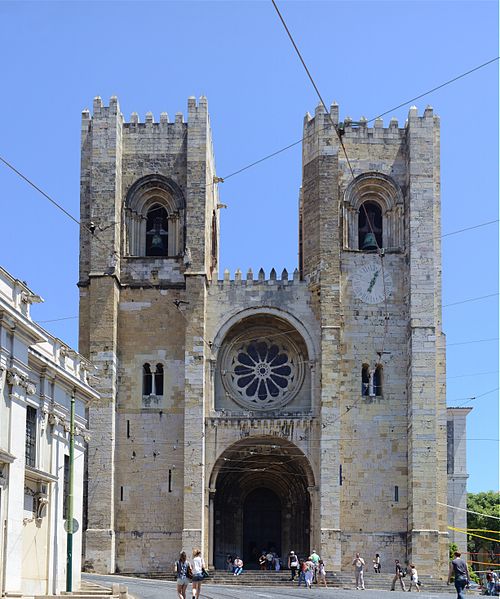
Back on the north bank, the oldest quarter of the city clings to the hill beneath the Castelo de São Jorge. The fortress itself, originally Moorish, later housed royal archives and now offers panoramic terraces over terracotta roofs and the river. Below, the Sé Patriarcal preserves the city’s Romanesque core beneath later Gothic and Baroque layers, while the narrow lanes yield miradouros that frame sudden vistas of the Tejo and the 25 de Abril bridge. Here the earthquake of 1755 barely scratched the surface, leaving a labyrinth that feels older than the kingdom.
Stadiums of passion and light
Modern Lisbon pulses in two great football cathedrals. The Estádio da Luz, home of Benfica, hosted the Euro 2004 final and the 2014 Champions League decider, its 68,100 seats sheltered by a translucent polycarbonate roof. Nearby, the Estádio José Alvalade, clad in yellow supports and rainbow seats, staged three Euro 2004 games and will host the 2024/25 Women’s Champions League final. Both stadiums sit within vibrant mixed-use districts where museums, cinemas and clinics share space with the roar of 50,000 voices.
Lifts that connect the layers
The city’s vertical soul is best felt in its historic lifts. The Elevador de Santa Justa, completed in 1902, lifts passengers 45 metres from the Baixa to the Chiado in two ornate wooden cabins, then deposits them on an iron bridge for views over the Baixa grid and the castle. The Ascensor da Glória, a water-ballast railway since 1885, climbs the Calçada da Glória at 16.3 per cent, its yellow-and-white cars offering glimpses of Lisbon’s steep façades and sudden belvederes like the Miradouro de São Pedro de Alcântara.
Art and power in the centre
At the heart of the Baixa, Praça do Comércio spreads its four-storey arcades around a vast rectangle, the Arco da Rua Augusta framing the river like a proscenium arch. Beneath the square, the Metro station links the financial heart to every district, while the Banco de Portugal, founded in 1846, guards the nation’s monetary history behind sober façades. A short walk north, the Museu Calouste Gulbenkian gathers 6,000 works—Egyptian papyri, Islamic lustreware, Rembrandt canvases and René Lalique glass—within a calm modernist envelope. Nearby, the Museu Nacional de Arte Antiga displays the 60-figure polyptych of Nuno Gonçalves alongside Bosch and Dürer in a palace that once belonged to the Marquês de Pombal’s brother.
Science and memory on the hill
On the opposite bank, the Academia das Ciências, founded in 1779, occupies the former Convento de Nossa Senhora de Jesus and houses a library of 360,000 volumes alongside the authoritative dictionary of contemporary Portuguese. A short climb brings you to the Igreja de Santa Engrácia, begun in the 1600s and completed only in 1966 as the National Pantheon, its Greek-cross plan and unfinished towers now serving as viewing platforms for the city. Inside, the marble and gilt shrine holds the remains of Amália Rodrigues, Eusébio and Luís de Camões.
Expo’s legacy by the river
At the eastern edge of the city, the Parque das Nações spreads across the former industrial docks of the Expo 98 site. The Vasco-da-Gama Tower, shaped like a billowing sail, still dominates the skyline at 145 metres, its observation deck offering sweeping views of the Tejo and the 25 de Abril bridge. Beside it, the twin São Gabriel and São Rafael towers flank the river, while the cable-stayed Ponte Vasco da Gama stretches north to Sacavém, a 17-kilometre ribbon of concrete and steel that completes Lisbon’s modern ring of connections.
See all places on the map