Dresden
17 places
Dresden’s skyline still carries the weight of three centuries. The city’s museums, palaces and riverbanks form a single story of power, art and science, told through stone, porcelain and glass. From the gilded halls of the Zwinger to the glass mannequin in the Hygiene Museum, each site adds a layer to the capital of Saxony. Walk the Elbe’s curve, and the buildings rise like acts in a single drama.
Baroque heart
The Zwinger stands at the centre of Dresden’s old town, a square of open-air corridors and fountains built between 1711 and 1728 for August the Strong. Its sandstone façades curve like theatre wings around the Semperoper and the Residenzschloss. Inside the courtyard, visitors pass from the Porzellansammlung’s blue-and-white wares to the Mathematisch-Physikalischer Salon’s brass telescopes. The stone galleries frame views of the Elbe, linking the palace to the river that once carried porcelain and power into the city.
Royal vaults
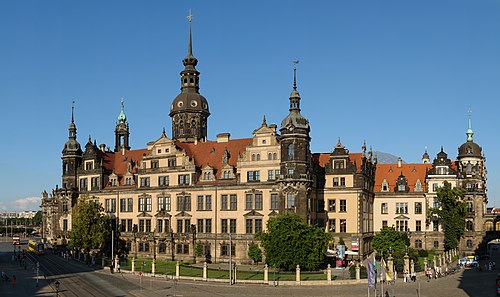
The Residenzschloss Dresden began as a medieval fortress and grew into a Renaissance palace under Moritz of Saxony. The Riesensaal, nearly sixty metres long, still echoes with the footsteps of electors and kings. Above it, the Grünes Gewölbe displays August the Strong’s jewels—the “Mohr with the Emerald Step” catches every eye. Below, the Rüstkammer holds 1,300 weapons in gilded cases, while the Türckische Cammer shows the spoils of Ottoman wars. The chapel’s blue tiles, rebuilt after 1988, catch the light like a promise kept.
Golden ruler
On the Neustädter Markt, the Goldene Reiter lifts August the Strong above his horse, gilt gleaming since 1736. The statue faces northeast, towards Poland that made him king, and the Neustadt district that still bears his mark. Latin inscriptions on the pedestal list his titles, while the surrounding square hums with cafés that spill onto cobbles worn smooth by centuries of trade. Restored in 2003 with half a kilogram of new gold leaf, the rider remains Dresden’s most photographed emblem.
Porcelain dreams
The Porzellansammlung inside the Zwinger holds twenty thousand pieces, from Ming bowls to Meissen figurines. The Dragon Vases, shipped from China in the 1720s, guard the entrance to the East Asia rooms. Nearby, the Meissen workshop displays kaolin clay and unfired models, showing how European kings tried to steal the secret of porcelain. In 2021, a rare Ru-ware shard was found here, proof that even fragments can rewrite history.
Prints and drawings
The Kupferstich-Kabinett, founded in 1720, keeps half a million works on paper in the Residenzschloss. Dürer’s “Praying Hands” and Rembrandt’s etchings share shelves with rediscovered drawings like Otto Greiner’s lost sheet, returned from Los Angeles in 2026. The Studiensaal lets scholars turn pages of fragile sketches, while temporary shows bring forgotten masters back to light. The building itself, restored after 1945, feels like a quiet archive of European thought.
Science and spectacle
The Mathematisch-Physikalischer Salon in the Zwinger displays the toys of Saxon curiosity. Andreas Gärtner’s burning mirrors focus sunlight into flame, while Blaise Pascal’s Pascaline, the only public example, clicks through calculations. A world-clock from 1784 still ticks off time zones, and a gallery of globes maps the earth as it was known then. The long gallery’s arched windows let daylight trace the curves of brass and glass instruments.
Coins and crowns
The Münzkabinett holds three hundred thousand coins, medals and banknotes in the Residenzschloss. Gold ducats from the 1500s sit beside silver thalers minted for Saxon miners. A case on “Mining and Coinage in Saxony” shows how ore became currency, while another room traces the evolution of paper money. The library beside the cabinets holds thirty thousand titles on numismatics, a quiet testament to the city’s role as a financial crossroads.
Body and mind
The Deutsches Hygiene-Museum rises in the Blüherpark, its neoclassical façade rebuilt after 1945. The permanent exhibition “Adventure Human” invites visitors to walk through a glass mannequin, peer into a giant ear, and trace the path of a sperm. Temporary shows tackle vaccination, pandemics and the ethics of enhancement. The museum’s 280,000 annual visitors leave with more than facts—they carry questions about health and society.
River palaces
Three Elbe palaces crown the right bank above Dresden. Schloss Albrechtsberg, built 1850–54 for Prince Albrecht of Prussia, glows in late-classical white. Its Kronensaal drips with gilded stucco, while the garden terrace looks down on steamers gliding past. Nearby, the two other Elbschlösser—Lossen and Pillnitz—share the same sandstone hue and river views. Pillnitz’s palace, once a summer retreat for Saxon kings, now hosts porcelain exhibitions in its orangery.
Sculptures old and new
The Skulpturensammlung splits its five-thousand-year story between the Semperbau and the Albertinum. Antique marbles from Rome stand beside medieval ivories, while Rodin’s “Thinker” broods in the modern wing. The Sculpture Hall displays 125 works, from DDR-era busts to contemporary casts. The building’s sandstone façade, pocked by war and restored, frames each era without flinching.
Panoramic memory
A former gasometer in Reick now holds Yadegar Asisi’s 360-degree canvases. “Dresden 1756” once drew half a million visitors in two years, while “Dresden 1945” shows the city after firebombs. A newer “Amazonien” transports viewers into tropical rainforest. The circular space turns slowly, letting the painted sky rotate above the heads of silent onlookers. Light from hidden projectors bleeds across the walls, making the past feel present.
Stage and society
The Staatsschauspiel Dresden performs in a rebuilt neobarock theatre on the Ostra-Allee. The main house seats 750, its three balconies curving like the Zwinger’s arcades. The Kleine Haus, once a church, now hosts experimental productions with movable seating. In 2024–25, 210,000 tickets were sold, filling three-quarters of the seats. The stage machinery, modernised in the 1990s, can shift sets in seconds, keeping the drama alive.
Valley of plenty
Beyond the museums, the Elbtalkessel stretches forty-five kilometres from Pirna to Meissen. The Elbe meanders through vineyards and orchards, its south-facing slopes yielding Riesling and sour cherries. The river’s curve shelters Dresden from the colder winds of the Ore Mountains, creating a microclimate warm enough for wine. In 2004–2009, this stretch was a UNESCO World Heritage Site, though the title was later lost. The hills still frame views of church
See all places on the map