Ankara
25 places
Ankara is the beating heart of modern Turkey, a city where ancient stones whisper stories of empires while glass towers and wide boulevards shape a capital that never sleeps. Built on a high plateau in central Anatolia, it rises between dry plains and wooded hills, its streets humming with the energy of five million people who call it home. Here, the past is never far away—Hittite tablets lie in museum cases, Roman baths crumble underfoot, and the marble mausoleum of Atatürk watches over the city from its hilltop perch. Yet Ankara is also a city of bold contrasts: a place where a thousand-year-old mosque shares a skyline with a glowing television tower, and where the quiet courtyards of Sufi shrines stand just metres from the roar of a basketball arena. This route traces the layers of Ankara’s identity—from the ruins of empires to the symbols of a young republic, from sacred spaces to spaces of power, all woven together by wide avenues and the steady pulse of daily life.
A city on the plateau
Ankara sits at the crossroads of Anatolia, its streets laid out on a high plateau where the central Anatolian steppe meets the foothills of the Köroğlu Mountains. The province stretches over 25,632 square kilometres, a patchwork of wheat fields, pine forests, and salt lakes that shimmer under the fierce sun. The Kızılırmak and Sakarya rivers carve slow paths through the land, while the Tuz Gölü, one of the saltiest bodies of water on earth, glistens in the south like a vast mirror. At 2,051 metres, Mount Işık stands sentinel over the region, its slopes often dusted with snow even when the city below swelters in summer heat. The landscape shifts dramatically—from the green northern ridges to the golden plains in the south—creating a natural stage for a city that has grown from a Phrygian hilltop fortress into a modern metropolis.
The resting place of a nation
On a man-made hill known as Rasattepe, the Anıtkabir rises like a white citadel, its travertine and marble gleaming under Ankara’s bright skies. This is the final resting place of Mustafa Kemal Atatürk, the founder of modern Turkey, whose mausoleum commands a vast landscaped park of 750,000 square metres. The monument was built between 1944 and 1953 after an international competition, its design chosen from over 49 submissions. The winning architects, Emin Onat and Orhan Arda, created a structure that blends neoclassical grandeur with Anatolian motifs, its long processional path lined with lion statues leading to the Hall of Honour. Inside, the museum traces Atatürk’s life through photographs, documents, and personal belongings. The surrounding Peace Park contains trees gifted from 24 countries, each planted as a symbol of international friendship.
Faith in stone and light
In the heart of Ankara, the Kocatepe Mosque stands as a beacon of Islamic architecture, its four slender minarets and sweeping dome visible from across the city. Begun in 1967 and completed in 1987, the mosque blends classical Ottoman design with modern engineering—its lower floors house a shopping arcade whose rents help fund the upkeep of the sacred space above. The interior is vast and airy, the central dome soaring over marble floors and stained-glass windows that scatter coloured light across the prayer hall. Just a short walk away, the Maltepe Mosque offers another vision of Ankara’s spiritual life. Built between 1954 and 1959, it is known for its 30-metre green dome and two 50-metre minarets, their balconies silhouetted against the Ankara sky. Both mosques sit in lively neighbourhoods where the rhythm of daily life flows around them—cafés spill onto pavements, children play in squares, and the call to prayer mingles with the hum of traffic.
Echoes of empires
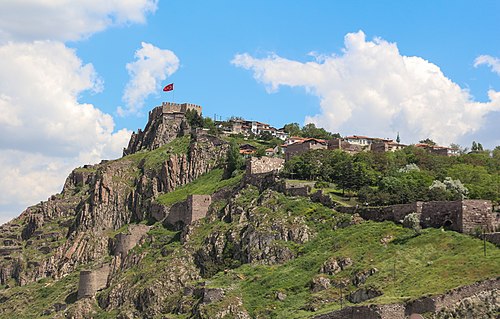
Ankara’s oldest quarter clings to the slopes beneath the city’s citadel, a labyrinth of stone houses and narrow alleys where the past feels alive. The Ankara Citadel, first built by the Hittites and later expanded by the Phrygians and Galatians, still guards the city from its 978-metre-high perch. Its sturdy walls and crumbling towers offer sweeping views over the modern grid below, where glass and steel rise beside ancient ruins. Nearby, the Temple of Roma and Augustus—known as the Monumentum Ancyranum—preserves one of the most important historical texts in Turkey. Carved into its walls is the Res Gestae, the political testament of Emperor Augustus, written in both Latin and Greek. Just metres away, the Hacı Bayram Mosque, built in the early 15th century for the Sufi poet Hacı Bayram-ı Veli, stands as a living link to Anatolia’s spiritual past. In 1920, this same mosque witnessed the opening of Turkey’s first Grand National Assembly, a moment that reshaped the nation.
Relics of ancient Anatolia
Beneath the watchful gaze of the citadel, the Museum of Anatolian Civilisations unfolds the story of Turkey from the Stone Age to the Ottoman era. Housed in two restored Ottoman buildings—a 15th-century caravanserai and a 15th-century covered bazaar—it is one of the country’s most important archaeological collections. The centrepiece is the Hittite section, where cuneiform tablets from Boğazköy tell of royal decrees and diplomatic letters, and monumental sculptures of gods and kings loom over visitors. Other galleries display artefacts from Çatalhöyük, the world’s oldest known settlement, and Alacahöyük, where Bronze Age princes were buried with gold and bronze treasures. The museum’s 1997 award as European Museum of the Year reflects its role as a guardian of Anatolia’s layered identity.
Power and memory in stone
On the western edge of the city, the Turkish State Cemetery stretches across 536,000 square metres of pine forest, a place where the nation honours its founders and defenders. Established in 1988 after an international competition, the cemetery is designed around the “Street of the Republic,” a ceremonial path lined with symbolic tombs. Here, the empty graves of figures like Marshal Fevzi Çakmak and General Kâzım Karabekir stand as monuments to courage, while a small museum preserves personal items of those interred. The architecture is spare and dignified, with pillared shelters and wide lawns that invite quiet reflection. It is a place where history is not just remembered but felt, where every stone and tree speaks of sacrifice and the fragile gift of peace.
A tower that watches the city
The Atakule Tower rises 125 metres above Ankara’s southern skyline, its white form glowing against the evening sky. Built in 1989 as both a television transmitter and a public landmark, it has become a symbol of the city’s modern ambitions. The observation deck offers panoramic views across Ankara’s sprawling districts, while the revolving restaurant turns slowly, offering diners a changing perspective of the plateau below. By night, the tower transforms into a canvas of light, its 10,000 LED pixels choreographing colourful displays that pulse in time with music. Below, the streets buzz with cafés, shops
See all places on the map