
📷 Image: Wikimedia Commons
Sengsengebirge
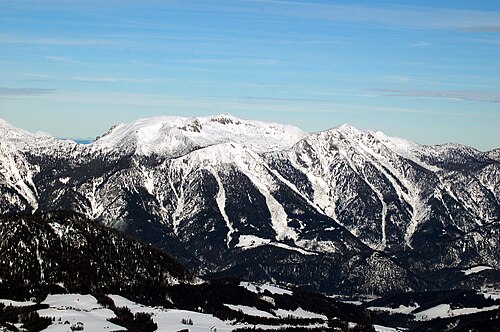
The Sengsengebirge is a folded mountain range in Upper Austria’s Pre-Alps, part of the Northern Limestone Alps. Made mostly of Wetterstein limestone, it drains underground and is cut through by large caves. The highest point is the Hohe Nock at 1,963 metres. Since 1976 much of the range has been a nature reserve, and since 1997 it has formed part of Kalkalpen National Park. Its name comes from medieval scythe forges that once used its forests. Mountain farming once thrived here, and early 20th-century tourism opened routes for hikers, skiers and climbers. The range stretches twenty kilometres from the Steyr in the west to the Krumme Steyrling in the east, covering about seventy-five square kilometres. Administratively it lies entirely in Kirchdorf district, shared by Molln, Rosenau, Roßleithen and St. Pankraz. Steep northern cliffs rise up to six hundred metres, while southern slopes are gentler with plateaus and alpine basins. Around the Hohe Nock and Gamsplan the land is marked by bowl-shaped cirques and karst depressions. Underground drainage feeds powerful springs such as the Vorderer Rettenbach, which flows at over a thousand litres per second. Visitors find a high karst plateau with bare limestone ridges and scattered alpine pastures. The Feichtau lakes lie at fourteen hundred metres below the Seehagelmauer, one fed by a spring, the other a stillwater without inflow. Caves such as the Klarahöhle, over thirty-one kilometres long, offer exploration for cavers. Ice caves like the Kraterschacht hold permanent ice deposits studied by scientists. Hiking trails cross the plateau and climb to the Hohe Nock, while climate stations record the cool, wet conditions typical of these limestone summits.
Opening hours and admission prices change with the season and are therefore not part of this text. Current details from the operator
Discover more in this region
Themes around Upper Austria


Nearby
🗺 Create a tour from these spots → ← Back to Oberösterreich ← All places to visit in Upper AustriaQR-Code