Stockholm
25 places
Stockholm is a city where water meets history, where every bridge and boulevard tells a story of power, culture and resilience. This archipelago capital blends royal grandeur with cutting-edge design, maritime adventure with urban energy, and living traditions with global ambition. From the vaulted halls of the Royal Palace to the pine-scented paths of Skogskyrkogården, the route traces the heart of Sweden’s capital across water, stone and memory.
Royal heart of the city
The Royal Palace stands at the centre of Stockholm, its pink façade rising above the waterfront like a living monument to Sweden’s monarchy. Built between 1697 and 1760 by Nicodemus Tessin the Younger, the baroque palace replaced an older fortress on the same site. Its four wings enclose a quiet courtyard, while the north façade opens toward the Norrbro bridge and the blue waters of the Riddarfjärden. Inside, rooms alternate between opulent styles: the Vita havet ballroom shimmers in gold, the Bernadotte Library glows with mahogany, and the Treasury displays crowns that have crowned kings for centuries. The changing colours of the exterior—once gold, now warm pink—reflect the evolving identity of the monarchy itself. Visitors walk through the Royal Armoury, where armour worn by Gustavus Adolphus still gleams, and the Treasury, where the 17th-century regalia of Sweden’s kings lie in state.
Island of memory and art
Djurgården is Stockholm’s green cultural island, where museums and memories grow side by side. The Vasa Museum houses the almost fully preserved warship Vasa, which sank on its maiden voyage in 1628 and was raised in 1961. Now housed under a copper roof shaped like masts, the ship rises in a 34-metre hall, its oak ribs still bearing the scars of battle. Nearby, Skansen brings Sweden to life with 150 relocated buildings—farmsteads, glassworks, a 17th-century church—set among pine forests and rocky shores. The Baltic Sea Science Center adds a modern twist, while the Thielska galleriet showcases Nordic art in a villa by the water. In summer, the island hums with music from Gröna Lund amusement park and the scent of waffles from Hasselbacken’s historic café.
Green sanctuary of remembrance
Skogskyrkogården is a forest cemetery where architecture and nature merge in quiet harmony. Designed between 1917 and 1940 by Gunnar Asplund and Sigurd Lewerentz, it won an international competition with its simple lines and thoughtful integration into the landscape. The Woodland Chapel, topped by Carl Milles’ golden angel, stands beside the Resurrection Chapel and the Crematorium’s Holy Cross Chapel. A winding path leads through pine and elm groves to evenly spaced graves, each marked by unadorned stones that reflect Sweden’s egalitarian ideals. With nearly 100,000 graves and 2,000 burials each year, it is Sweden’s second-largest cemetery and a UNESCO World Heritage Site. The site’s design—once controversial, now celebrated—has made it a model for modern burial grounds across the world.
Waterfront stage of song and sport
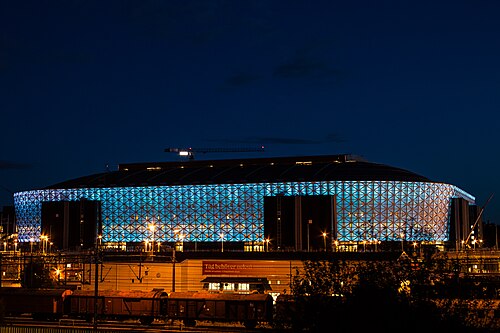
The Globen City rises in southern Stockholm as a sphere of glass and steel, its mirrored surface reflecting the sky. The Avicii Arena, built in 1989, was once the world’s largest spherical building, its 110-metre diameter supported by a MERO space frame. Inside, up to 16,000 spectators gather for concerts and sporting events, from the Eurovision Song Contest to ice hockey finals. The SkyView glass lifts carry visitors to the roof in transparent gondolas, offering views across the city. Nearby, the Tele2 Arena hosts football and concerts, while the Globen Shopping Mall and hotel complete the complex. Together, they form a hub where music, sport and commerce pulse in time with the city’s rhythm.
Modern temple of money and power
The Swedish Central Bank, or Riksbank, sits in a bold concrete block near the Old Town, its 1970 building a landmark of Nordic brutalism. As Sweden’s central bank, it issues currency, sets monetary policy and has pioneered digital money with the planned e-krona. Founded in 1656 as Stockholm’s Bank, it issued Europe’s first banknotes but collapsed in the Copper Crisis of 1668. Reborn as Riksens Ständers Bank, it gained sole rights to issue notes in 1897 and introduced negative interest rates in 2009. Today, its austere halls house centuries of financial history, from Johan Palmstruch’s early paper money to the algorithms shaping Sweden’s cashless future.
Crown jewel of civic pride
The Stockholm City Hall crowns Kungsholmen island with a tower that reaches 106 metres into the sky. Built between 1911 and 1923 by Ragnar Östberg, its National Romantic style blends Swedish tradition with Mediterranean grace. The Blue Hall, where the Nobel Banquet is held each December, glows with golden mosaics, while the Golden Hall shimmers with 18 million tiles depicting Swedish history. The 365 steps to the tower wind past murals by Prince Eugen and statues by Carl Eldh, each step echoing the city’s civic pride. At its base, the original wooden gate from the 17th-century warship Riksäpplet reminds visitors that this hall was built on Sweden’s maritime past.
Old Town’s living lanes
Gamla stan is Stockholm’s medieval core, a labyrinth of cobbled lanes and pastel façades squeezed onto the island of Stadsholmen. The 13th-century Storkyrkan, Stockholm’s cathedral, houses Bernt Notke’s carved Saint George slaying the dragon, while the Royal Palace looms nearby, its baroque wings framing the Slottsbacken slope. Narrow streets like Köpmangatan and Svartmangatan wind past the Tyska kyrkan, a 17th-century German church, and the Stortorget square, once the site of the old town hall. After a fire in the 17th century, straight new streets like Stora Nygatan cut through the chaos, but the medieval street plan remains, a palimpsest of Stockholm’s birth.
Athletic arena of champions
The Olympiastadion has stood sentinel over Stockholm’s sporting life since 1912, when it hosted the Olympic Games. Designed by Torben Grut, the arena welcomed 25,000 spectators in 1912 and 28,848 for a bandy final in 1959. Djurgårdens IF played here from 1936 until 2013, while the Diamond League’s DN Galan athletics meet still draws crowds each summer. The stadium’s protected status preserves its 1910s architecture, yet it adapts to modern needs, hosting concerts by U2 and Coldplay. From the marathon’s finish line to the roar of bandy finals, it remains a living stage for Swedish sport.
Cultural crossroads on the water
Skeppsholmen is Stockholm’s island of art and architecture, where modern design meets maritime heritage. The Moderna Museet, rebuilt in 1998 by Rafael Moneo, displays modern and contemporary art in a building
See all places on the map