Brussels
25 places
Brussels is more than a capital; it is a living museum of power, art and everyday defiance, where every street corner tells a story of compromise and creativity. The city’s 19 communes share one name yet speak two tongues, French and Dutch, their bilingual signs marking a federal experiment that has kept Belgium intact since 1995. Here, medieval spires rise above EU glass towers, while bronze urchins watch from alleyways, their mischief a reminder that humour survives politics. From the iron lattice of the Atomium to the gilded halls of the Royal Palace, the route traces a single day’s walk through the institutions that run a continent and the landmarks that make a nation laugh.
Heart of the city
The Grand-Place is the stage where Brussels performs its identity. Its Gothic town hall, built 1401–1421 by Jacob van Tienen, still towers 96 metres above the square, its spire crowned by the archangel Michael slaying a demon. The baroque facades opposite, rebuilt after the French bombardment of 1695, glitter with gold leaf and stone scrolls, each guild house a chapter in the city’s merchant past. At night, the floodlights pick out every corbel and crocket, turning cobbled lanes into a theatre of light. Beneath the arcades, chocolatiers and florists keep the medieval market alive, their wares laid out on the same stones trodden by dukes and revolutionaries.
Bronze rebels
Two tiny figures guard Brussels’ cheekiest tradition. The Manneken Pis, a 61-centimetre bronze boy who has been urinating since the 14th century, stands at the corner of rue de l’Étuve and rue du Chêne. His legend tells of Julian, a boy who extinguished a fuse with his mouth, saving the town from explosion. Since 1698 the statue has worn costumes for festivals, and today 950 outfits fill the museum beside him. A few hundred metres away, Jeanneke Pis, a 50-centimetre girl in a narrow alley called Impasse de la Fidélité, completes the pair. Created in 1985, she leans against the wall, grinning at passers-by who stop for photographs before moving on to the next pint at the Delirium Café.
Gothic heights
The twin towers of St Michael and St Gudula rise above the Treurenberg hill like sentinels of faith. Begun in 1226, the cathedral’s nave mixes Romanesque crypts with Gothic vaults and baroque pulpits, its 1200 stained-glass windows casting coloured light over royal weddings and state funerals. The 69-metre spires, finished only in the late 15th century, dominate the skyline, their silhouettes familiar to anyone crossing the city centre. Inside, the marble tomb of Duke John II of Brabant and the carved stalls by Henri-François Verbruggen show how art served both church and crown.
Art across centuries
The Royal Museums of Fine Arts gather seven houses along the Rue de la Régence, each wing a different era. The Museum of Ancient Art holds Brueghel’s Winter Landscape with Skaters and Rubens’ Coronation of the Virgin, while the Magritte Museum devotes rooms to the bowler-hatted men and floating apples of Belgium’s surrealist master. In Ixelles, the Antoine Wiertz Museum displays the painter’s colossal canvases of doomed lovers, and the Constantin Meunier Museum turns industry into poetry. Underground galleries link the buildings, their curved light shafts guiding visitors from medieval altarpieces to contemporary installations.
Modern marvel
The Atomium is Brussels’ answer to the space age, a 102-metre iron crystal built for Expo 58. Nine spheres, each 18 metres wide, represent the cubic cell of an iron crystal magnified 165 billion times. Visitors ride the lift to the top restaurant in 23 seconds, then climb through sloping tubes lit by changing colours to reach the viewing platforms. The structure’s stainless-steel skin, renewed in 2004–06, gleams against the sky, while the lower spheres host temporary exhibitions on science and design. From the terrace, the city unfolds in grids and parks, a view that links atomic theory to urban reality.
Power in stone
The Royal Palace faces the Palaces of the Nation across the Royal Park, its neobaroque façade the work of King Leopold II. Though the Belgian royal family has lived at Laeken since 1935, the palace still hosts state receptions in halls where gilded mirrors reflect ceilings painted with allegories of trade and justice. Nearby, the Town Hall on the Grand-Place, completed 1455, survived the 1695 bombardment that destroyed most of the square and now shelters neo-Gothic council chambers. Together they frame the political heart of a country that governs itself through compromise.
Green oases
The Parc du Cinquantenaire stretches east from the city centre, its triumphal arch and colonnades built for the fiftieth anniversary of Belgian independence in 1880. Below the green copper dome, museums of military and automotive history draw visitors into Belgium’s past, while the surrounding gardens offer quiet benches beneath plane trees. A short walk west lies the smaller Astrid Park, once the Meir Park, where Anderlecht’s Lotto Park stadium now stands. The contrast between leafy squares and packed terraces shows how Brussels balances leisure and life.
European stage
The Berlaymont building, headquarters of the European Commission, dominates the skyline with its cross-shaped tower at the Robert Schuman roundabout. Built 1963–67 and renovated after asbestos removal in 2004, it houses the offices of the Commission president and 26 commissioners. Across the rue de la Loi, the European Council and the External Action Service share the same district, their glass and steel facades reflecting the ambitions written into the treaties. Inside the Berlaymont, meeting rooms and press centres hum with the language of compromise that keeps twenty-seven nations speaking as one.
Senate chamber
The Palaces of the Nation, home to the Belgian Senate, stand on the opposite side of the Royal Park. The red upholstery of the Senate’s hemicycle echoes the British House of Lords, yet its 60 members are chosen by regional parliaments to represent Flanders, Wallonia and Brussels. The chamber’s semicircular benches and the “alarm bell” that rings during disputes remind visitors that Belgium’s federal structure is a daily negotiation. Above the speaker’s chair, the tricolour and the lion of Flanders share the wall, symbols of a country that turns difference into strength.
Banking bastion
The National Bank of Belgium on Boulevard de Berlaimont keeps the country’s money steady. Since 1850 it has managed reserves, issued currency and published the Financial Stability Report, working with the European Central Bank in Frankfurt. Visitors can exchange damaged notes or consult economic data in the public areas, while behind the scenes analysts track risks across Europe. The building’s sober stone façade hides vaults that hold gold and data, a quiet guardian of the euro that underpins daily life from Brussels to the Baltic.
Football cathedrals
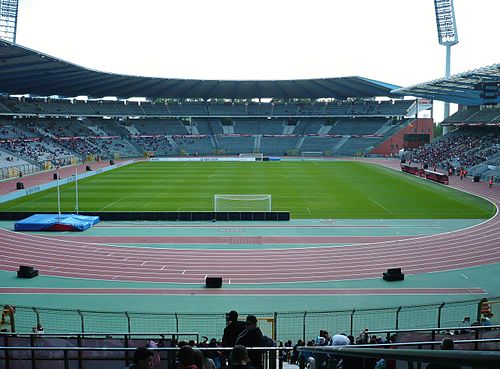
Two stadiums echo the city’s passion for sport. The King Baudouin Stadium, rebuilt after the Heysel disaster of 1985, hosts athletics and football, its 50,000 seats
See all places on the map