Archaeology · Amesbury
Stonehenge
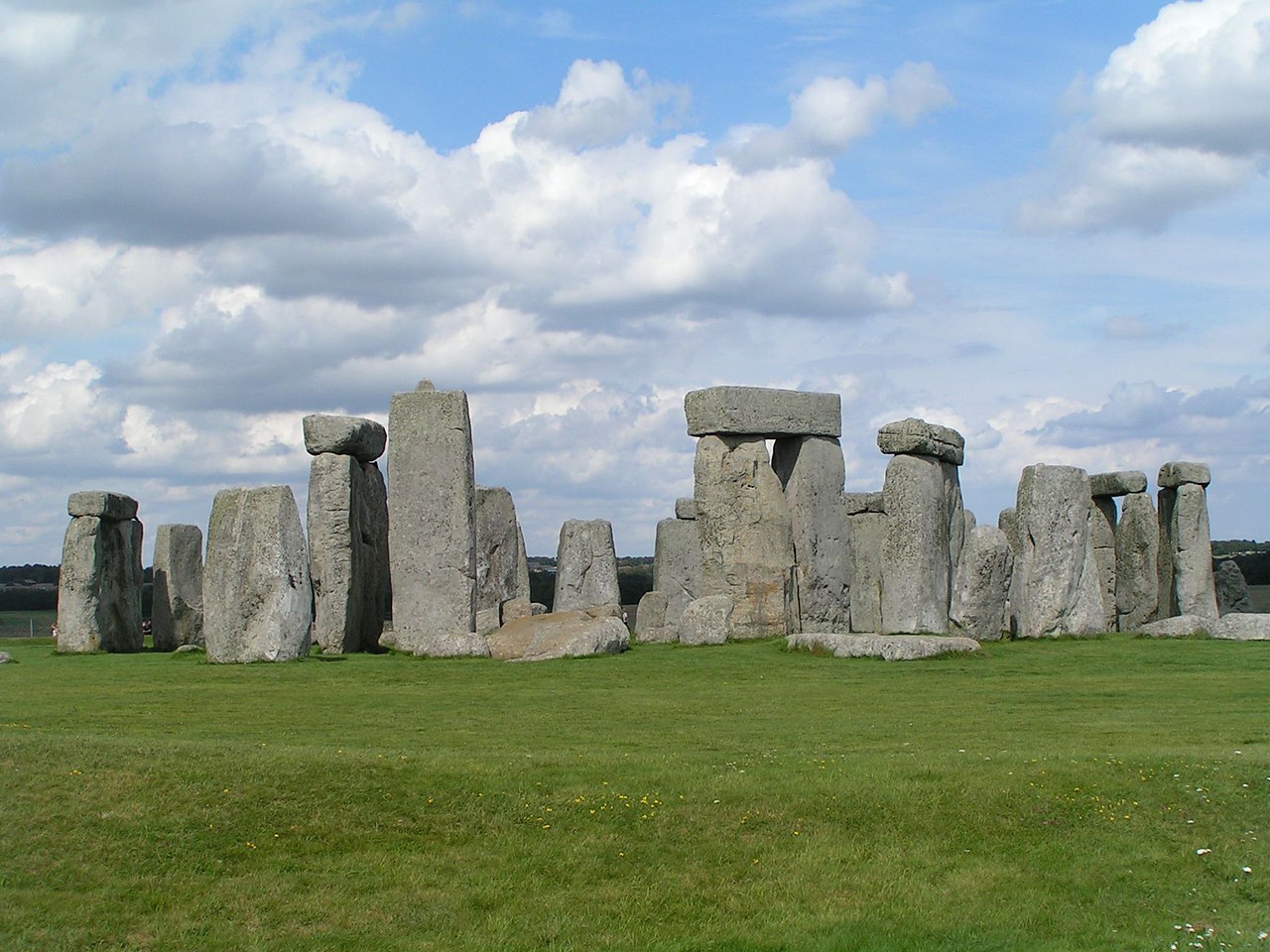
Image: Stefan Kühn · CC BY-SA 3.0 · Wikimedia Commons
Stonehenge stands on Salisbury Plain near Amesbury, a vast open grassland where the wind moves freely across the chalk downs. The site is a circle of standing stones arranged in layers, with huge sarsens forming the outer ring and smaller bluestones inside. These stones weigh up to twenty-five tons each and were set upright more than four thousand years ago without metal tools. The monument is surrounded by earthworks and burial mounds from the Neolithic and Bronze Ages, making it part of a much larger ancient landscape.
Archaeologists believe Stonehenge was built in several stages between 3100 BC and 1600 BC, with the famous sarsen circle raised around 2600–2400 BC. Excavations led by Mike Parker Pearson found over fifty thousand cremated bone fragments from sixty-three people buried in the Aubrey Holes, showing it was used as a burial ground early on. The stones are aligned so that the sun rises over the heel stone at summer solstice and sets at winter solstice, marking the changing seasons.
Visitors walk around the outer bank and ditch before approaching the stones themselves. Inside the circle, the arrangement of trilithons—pairs of tall sarsens joined by lintels—creates a sense of ancient craftsmanship. The bluestones, brought from Wales, stand in the centre, their colour contrasting with the grey sarsens. The wide grassy plain stretches away in all directions, with other ancient sites nearby, giving a feeling of stepping back into a distant past.
Sources (1)
- Stonehenge (Wikipedia) (CC BY-SA 4.0, adapted)
Nearby
What lies right next door.

© Wikityke at English Wikipedi… · CC BY-SA 3.0 Landmarks · 58 m
Stonehenge, Avebury and Associated Sites

© Heikki Immonen · CC BY 3.0 Landmarks · 72 m
Heel Stone

© Derek Harper · CC BY-SA 2.0 Landmarks · 770 m
Bush Barrow

© Psychostevouk (talk) · Public domain Archaeology · 791 m
Stonehenge Cursus
Archaeology · 1.2 km
Linear boundary within Normanton Gorse
Archaeology · 1.2 km
King Barrow Ridge