📷 Image: Wikimedia Commons
Battersea Railway Bridge
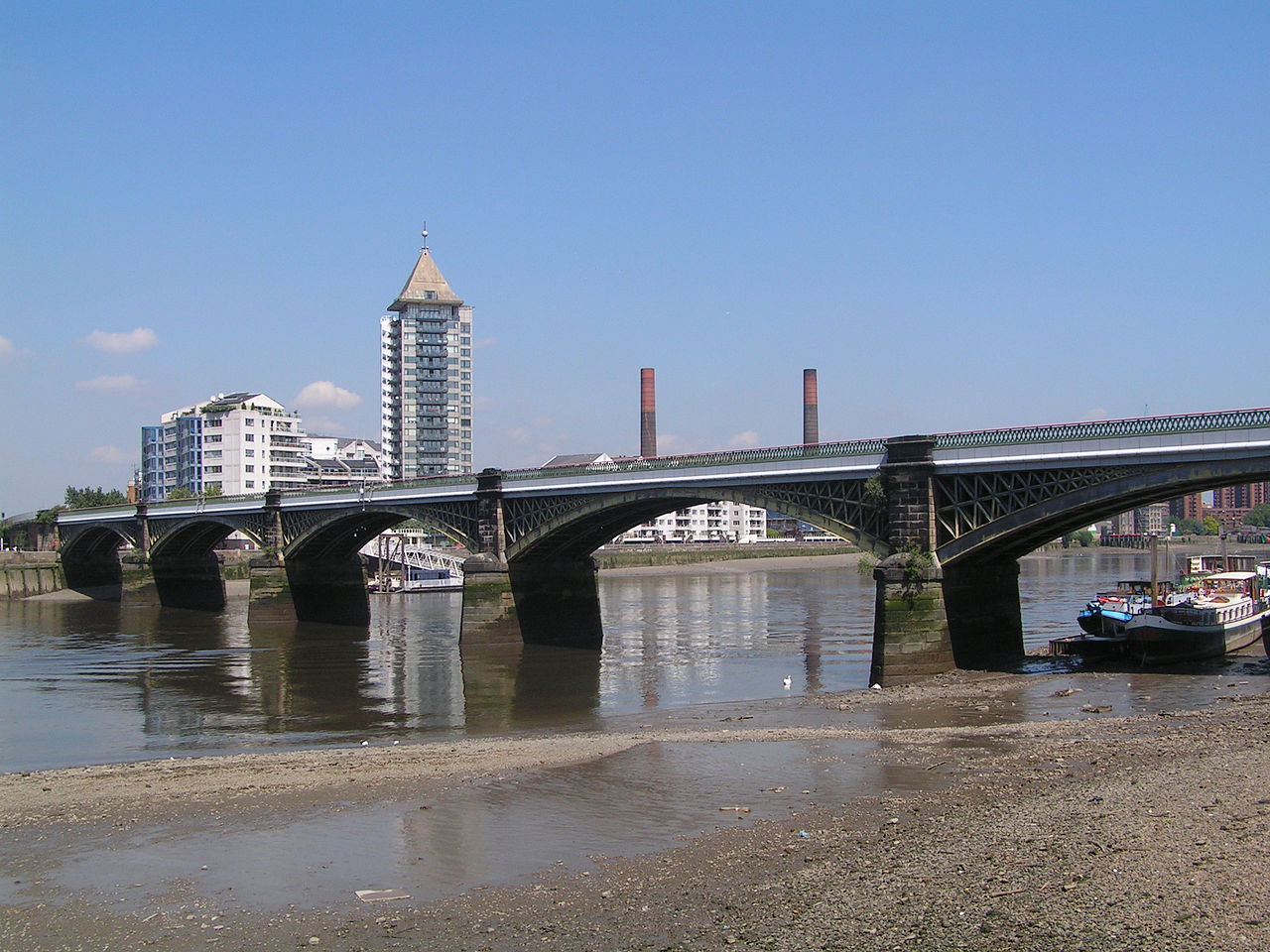
Battersea Railway Bridge carries the West London Line across the Thames between Battersea and Fulham. Built in 1863, it is one of the oldest railway bridges still in use in London. The bridge has five wrought-iron arches and brick approach viaducts on each side. It was designed by William Baker and T. H. Bertram for the London and North Western Railway and the Great Western Railway. The contractors Brassey and Ogilvie completed the structure at a cost of £87,000. Originally it carried both standard and broad gauge tracks to connect the Channel Ports with the Great Western Railway. The bridge is now a Grade II* listed structure, recognised for its historic and architectural importance. It is the most complete of the six railway bridges built in the 1860s and one of the earliest to span the Thames. The bridge has been refurbished several times, most recently between 2013 and 2014. Repairs were also carried out after a refuse barge struck it during high tide in 2003. Trains crossing the bridge travel at speeds limited to 20 or 30 miles per hour. Visitors walking the Thames Path can pass under the bridge on both sides. On the north side a three-arch brick viaduct has an arch opened as a pedestrian route. On the south side, two of four arches serve houseboat residents and another provides access near Lombard Wharf. The bridge’s piers and parapets remain largely unchanged since the 19th century, with wrought-iron railings and stone ashlar finishes still visible.
Opening hours and admission prices change with the season and are therefore not part of this text. Current details from the operator
Discover more in this region
Themes around England
All themes in England →
Nearby
- Sands End45 m
- London Heliport380 m
- St Mary's Church, Battersea475 m
- Cremorne Gardens742 m
- Heatherley School of Fine Art677 m
- Chelsea Theatre890 m
QR-Code