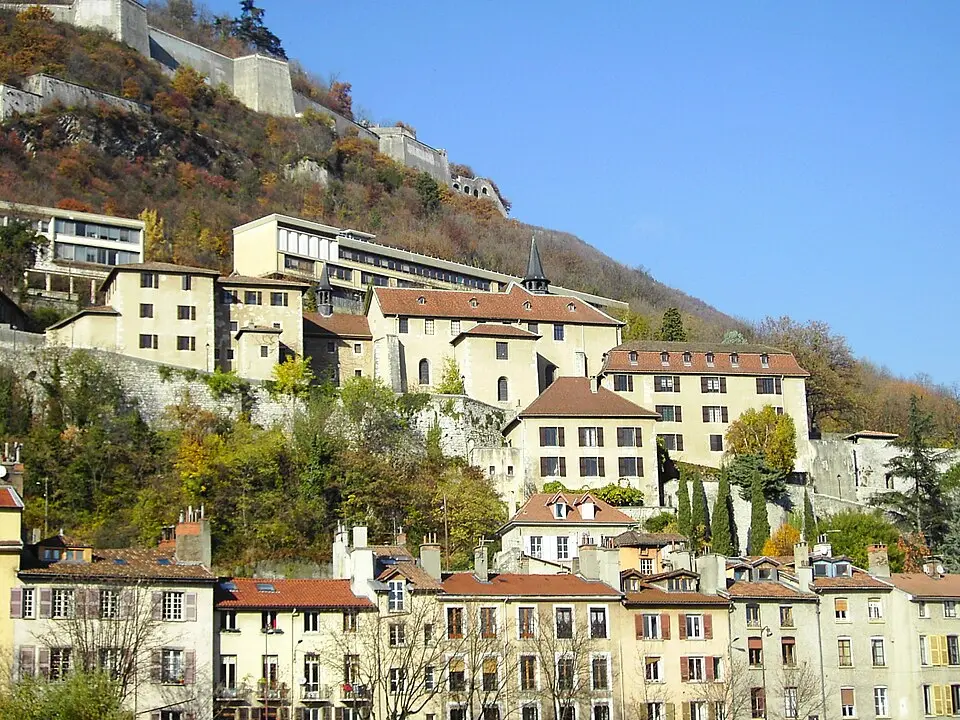
Grenoble lies in south-eastern France where the Isère receives the Drac. Nestled between the pre-Alpine massifs of the Vercors, Chartreuse and Belledonne, peaks almost three thousand metres high rise only a few kilometres away. The city centre, at about two hundred metres above sea level, is a junction between Lyon, Geneva and the Côte d’Azur. The densely built district of Île Verte is one of the most intensively developed areas in the city.
Its origins go back to the time of the Allobroges, a Celtic tribe. Under the name Cularo, the place first appears in Roman times; later it was renamed Gratianopolis in honour of Emperor Gratian. In the Middle Ages Grenoble developed into the spiritual and political centre of the region, received town privileges and housed one of France’s oldest universities. The city played a key part in the French Revolution when its representatives helped shape the Tennis Court Oath. During the Second World War Grenoble became a scene of resistance and repression before being liberated in 1944.
Today Grenoble is known for its modern cable car to the Bastille, regarded as the world’s first urban cable car. The city combines high technology with alpine tradition, for example through the European Synchrotron at the confluence of the Drac and Isère. As host of the 1968 Winter Olympics, Grenoble became a symbol of modern France. Its university and research institutions such as CEA or ESRF make it one of Europe’s most important scientific locations.