Ljubljana
25 places
The central Slovenian region cradles Ljubljana like a palm, its 2560 square kilometres of rolling hills and river meadows forming a living frame for the capital’s story. Here the Ljubljanica curves through the land, carrying centuries of trade, craft and culture from the medieval lanes of the old town to the modern stadiums on the northern edge. The region’s 554,000 residents live between the quiet villages of the countryside and the city’s grand boulevards, all united by the river’s gentle pulse and the green hills that rise behind the castle.
Castle on the hill
Laibacher Burg rises above the rooftops, its stone walls dating back to the twelfth century when it began as a fortress against invaders. By the sixteenth and seventeenth centuries it had become the seat of the Carniolan lords, its present silhouette shaped by military needs and later restorations. Today the complex houses museums that trace Slovenia’s past, from puppet shows to armoury displays, while a funicular from Krek Square lifts visitors up the slope in minutes. At the summit the view stretches over terracotta roofs and the Ljubljanica’s silver ribbon, the city laid out like a map beneath the castle’s shadow.
Green lungs of the city
The Tivoli-Park stretches for five square kilometres west of the centre, its Jakopič Promenade leading from the old town to the wooded Rožnik hill. Along the way fountains play among flowerbeds, and the International Centre of Graphic Arts occupies the former Tivoli Castle. The park’s paths wind past outdoor exhibitions, playgrounds and the Ljubljana Zoo, where giraffes and zebras share the lower slopes with a working Slovenian farm. At dusk the air carries the scent of lime trees and the distant hum of tram lines, a reminder that nature and city live side by side.
Three bridges, one river
Tromostovje arches over the Ljubljanica at the Prešeren Square, its three spans built across nine centuries. The middle bridge, once named for Archduke Franz Karl, still carries pedestrians while the flanking walkways ease the flow of daily life. Since 2021 the trio has been part of Jože Plečnik’s urban ensemble on the UNESCO World Heritage list, a human-scale design that turns a simple river crossing into a stage for the city’s rhythm. Below, the water reflects the baroque facades and the ever-changing light of the Slovenian sky.
Market by the water
The Central Market building curves along the Ljubljanica like a stone wave, its half-moon windows opening to the water and the bustle of the Vodnik and Pogačar squares. Designed by Plečnik in the 1930s, the hall blends Renaissance motifs with modern engineering, its colonnades sheltering stalls of fresh produce, cheese and flowers. Outside, farmers sell honey and herbs on the open squares, while the river’s gentle lapping provides a constant soundtrack to the city’s daily trade.
National gallery of living art
The Slowenische Nationalgalerie stands on Prešernova cesta, its neorennaissance façade rising beside the glass link that connects old and new wings. Inside, Slovenian art from medieval altarpieces to impressionist landscapes fills the rooms, while the post-modern wing shows contemporary works in bright, airy spaces. The building itself tells a story of cultural ambition, from its origins as a “people’s house” in 1896 to the glass atrium added in 2001 that welcomes visitors into the heart of the collection.
A skyline in miniature
The Nebotičnik tower rises 70 metres above the city centre, its thirteen floors packed with shops, offices and a café that turns into an observation deck at dusk. Built in 1933 as Yugoslavia’s tallest building, its art-déco lobby gleams with Karst marble and a spiralling staircase, while the upper floors offer panoramic views across the red roofs to the distant hills. The tower remains a vertical slice of Ljubljana’s twentieth-century ambition, standing sentinel over the everyday life below.
Stadium and arena in one park
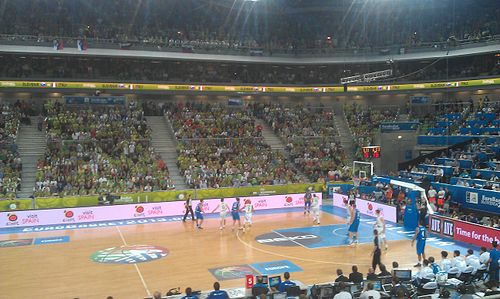
The Športni park Stožice brings sport to the northern edge of the city, where the 16,038-seat Stadion Stožice shares the grounds with the Arena Stožice and a shopping centre. The stadium hosts football matches for NK Olimpija and the national team, while the arena’s shell-shaped roof shelters concerts and handball finals. Together they form a compact sports city, its car parks and walkways linking the roar of the crowd to the quiet streets of Bežigrad.
Where history sleeps
The Žale cemetery spreads across Bežigrad like a park of memory, its 150,000 graves shaded by lindens and yews. Among them lie the architect Jože Plečnik, the writer Ivan Cankar and the composer Rihard Jakopič, while the Plečnik Žale section holds an ossuary for 5,258 First World War victims. The newest part, Nove Žale, opened in 1988, keeps the tradition alive with quiet lawns and modern chapels set against the green backdrop of the city.
Art in the margins
Metelkova occupies a former barracks near the main railway station, its graffiti-covered walls and repurposed warehouses now hosting galleries, clubs and hostels. Since squatters took over the site in 1993 the place has become a laboratory for alternative culture, its stages hosting free jazz, punk and techno gigs while LGBTQ+ and anti-racist groups hold workshops. The complex survives despite threats of demolition, a living reminder that art often thrives on the edges of the official map.
A garden of global flora
The Botanical Garden of the University of Ljubljana sits beside the Gruber Canal in the quiet district of Rudnik, its two hectares home to more than 4,500 plant species. A third of the collection grows wild in Slovenia, while the rest arrives from Europe and beyond, tended by botanists who also conserve rare endemics. Visitors enter via the Hladnik Bridge from the Špica Park, following paths that lead past orchids, magnolias and the first trees planted when the garden opened in 1810.
From medieval fortress to modern stage
The Dom St. Nikolaus dominates the skyline between the Ciril-Metodov and Pogačar squares, its baroque façade rising above the rooftops. The cathedral began as a romanesque church in the thirteenth century, survived fires and Ottoman raids, and finally gained its present form in the early 1700s under the hands of Andrea Pozzo and Francesco Bombasi. Inside, the frescoed ceiling by Giulio Quaglio and Robba’s side altars share space with bronze doors that tell the story of Slovenia, while the 1911 Milavec organ fills the nave with sound.
Bridge of dragons and dreams
The Dragon Bridge leaps over the Ljubljanica with four copper dragons perched at each corner, their wings spread above the river. Built in 1901 as the city’s first reinforced-concrete bridge, it replaced a wooden structure from 1819 and became an instant symbol of Ljubljana. The 33-metre arch carries trams and pedestrians from the railway station up to the castle hill, its art-nouveau candelabras glowing at night like lanterns on a dragon’s back.
The heart of the city
Pre
See all places on the map