📷 Image: Wikimedia Commons
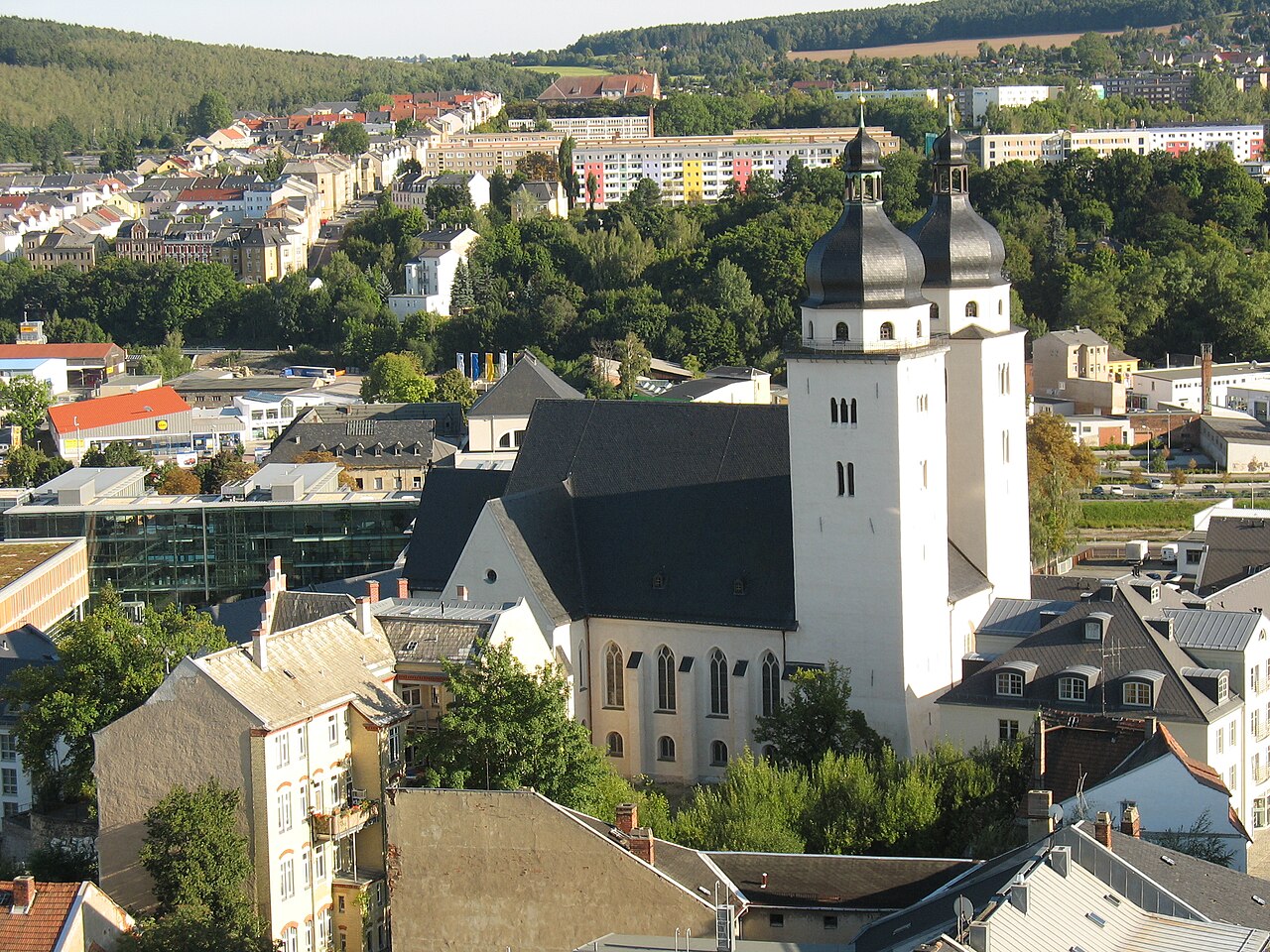
St. John's Church
The Johanniskirche stands on a hilltop where the east and south flanks of a steep slope drop down to the valley of the White Elster. Its first church was mentioned in 1122, making Plauen one of the oldest towns in the region. The present building began as a three-aisled basilica around 1224, with later Gothic additions. Two 52-metre towers dominate the skyline after the 19th-century rebuild. Inside, the Vogts’ chapel holds the tomb of a 13th-century prince and his wife in its vault. The church has survived fires, wars and restorations that removed most original furnishings. The church’s history is tied to the German Order, which settled in Plauen in 1214. Vogt Heinrich IV granted the order the parish and surrounding lands in 1224. By 1281 the order had become one of the most powerful in Thuringia. The basilica’s crossing, transepts and choir were completed by the mid-13th century. Six-part ribbed vaults and a large central boss show later Gothic influence. A two-storey annex, possibly the former Marienkapelle, served as a sacristy with a two-bay ribbed vault. Visitors enter through the twin-towered west front rebuilt after the Second World War. The interior now holds an altar from Neustädtel, a pulpit from Görlitz and sculptures and paintings from the Vogtland Museum. The 1966 organ was restored in the 1990s. Outside, the hilltop site offers views over the Elster valley. The surviving tower of the old town wall nearby is called the Nonnenturm after a nearby Dominican house. The church remains the main Protestant parish church of Plauen.
Opening hours and admission prices change with the season and are therefore not part of this text. Current details from the operator
Discover more in this region
Themes around Saxony


Nearby
- Deutschordenskommende Plauen0 m
- City fortification Plauen24 m
- König-Albert-Brunnen166 m
- Plauen221 m
- Plauen Lace Museum205 m
- castle of Plauen278 m
QR-Code