Landmarks · Abbey Dore
Dore Abbey

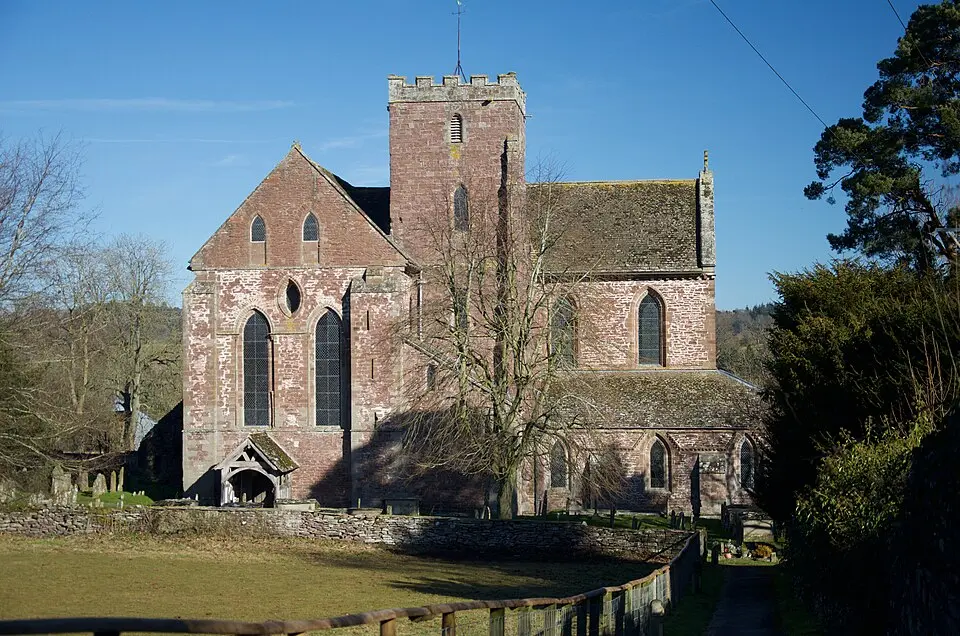
Dore Abbey stands in the village of Abbey Dore within the Golden Valley in Herefordshire. A Cistercian monastery founded in 1147 by Robert fitzHarold of Ewyas, it became a daughter house of Morimond Abbey in France after he met the abbot on the Second Crusade. Construction began around 1175 in local sandstone, following the design of Morimond with a presbytery, transepts, crossing and nave. The abbey grew wealthy through wool sales and land grants, including from King John in 1216. By 1260 it was called a sumptuous church, and in 1282 the rebuilt structure was consecrated by Thomas de Cantilupe, Bishop of Hereford.
The abbey’s later history reflects national change. After the Dissolution in 1536 it passed to John Scudamore, whose descendant John Scudamore, 1st Viscount Scudamore, restored it in the 1630s. The medieval altar was found being used on a farm and returned to the church. A new oak rood screen was carved by John Abel of Hereford, incorporating the arms of Scudamore, Laud and King Charles I. Further work followed in the early 18th century, and in 1901–09 local architect Roland Paul partly excavated the original foundations.
Today the building serves as the parish church of Holy Trinity and St Mary. Parts of the 12th- and 13th-century fabric remain, including transepts, columns, tiles and stained glass fragments. Two 13th-century effigies lie within, thought to be Lord Robert of Ewyas and Roger de Clifford. The churchyard holds the war grave of Driver William John Watkins of the Royal Field Artillery. Plain walls still carry 17th- and 18th-century paintings and texts, while buried foundations trace the outline of the vanished abbey beneath the grass.
Sources (1)
- Dore Abbey (Wikipedia) (CC BY-SA 4.0, adapted)
Nearby