📷 Image: Wikimedia Commons
Little Solsbury Hill
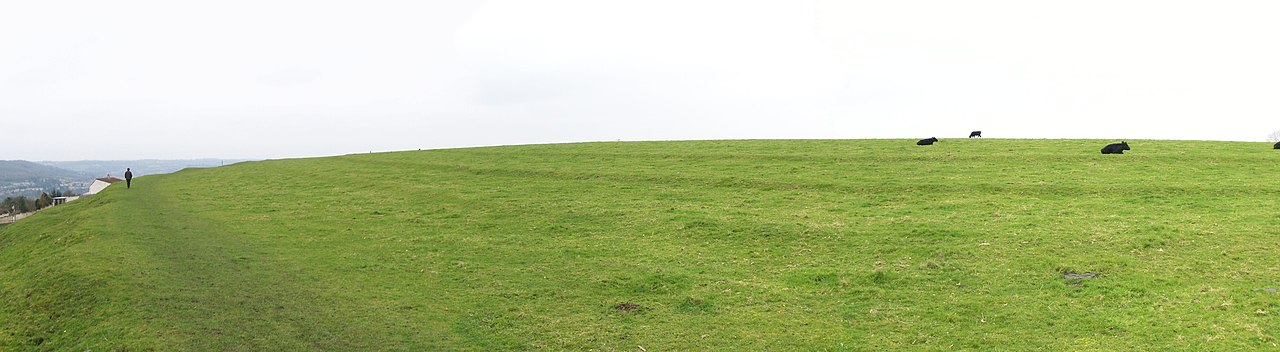
Little Solsbury Hill stands above the village of Batheaston in Somerset, a flat-topped rise of 191 metres reached by a short walk from the valley. The River Avon lies just over two kilometres to the south, and from the summit the city of Bath appears framed by the Cotswolds. The hill is capped by an Iron Age fort whose single rampart once stood four metres high and twenty metres wide. Beneath the turf are layers of Jurassic limestone, oolite and sandstone that slip and slide after rain. A turf labyrinth was cut into the slope in the 1990s by protesters against the A46 bypass. The hill’s Iron Age enclosure was occupied between 300 BC and 100 BC, then burnt and abandoned during the Belgic invasion. Medieval farmers later laid out ridge-and-furrow fields across the summit, traces of which still show after centuries of grazing. The hill may also be the site of the Battle of Badon where, according to Gildas and Nennius, Britons under Arthur fought Saxons around AD 496. In 1930 the National Trust took ownership, preserving both the ancient earthworks and the limestone grassland. Visitors follow paths that wind through calcareous turf alive with bird’s-foot trefoil, harebells and chalkhill blue butterflies. Roe deer move quietly between the scrub, while skylarks rise above the slopes and common buzzards circle overhead. The view stretches south to Bath’s spires and north across the Cotswold plateau. A small turf maze cut by protesters marks one edge of the hill, a reminder of more recent conflicts. The hill’s name may come from the Celtic god Sulis, linking it to the thermal springs at nearby Bath.
Opening hours and admission prices change with the season and are therefore not part of this text. Current details from the operator
Nearby
- Bathampton Toll Bridge1.1 km
- Bath Easton Museum1.1 km
- Church of St Nicholas, Bathampton1.7 km
- Rondo Theatre1.8 km
- Church of St Saviour1.8 km
- Cleveland Pools2.3 km
QR-Code