📷 Image: Wikimedia Commons
Southwark Cathedral
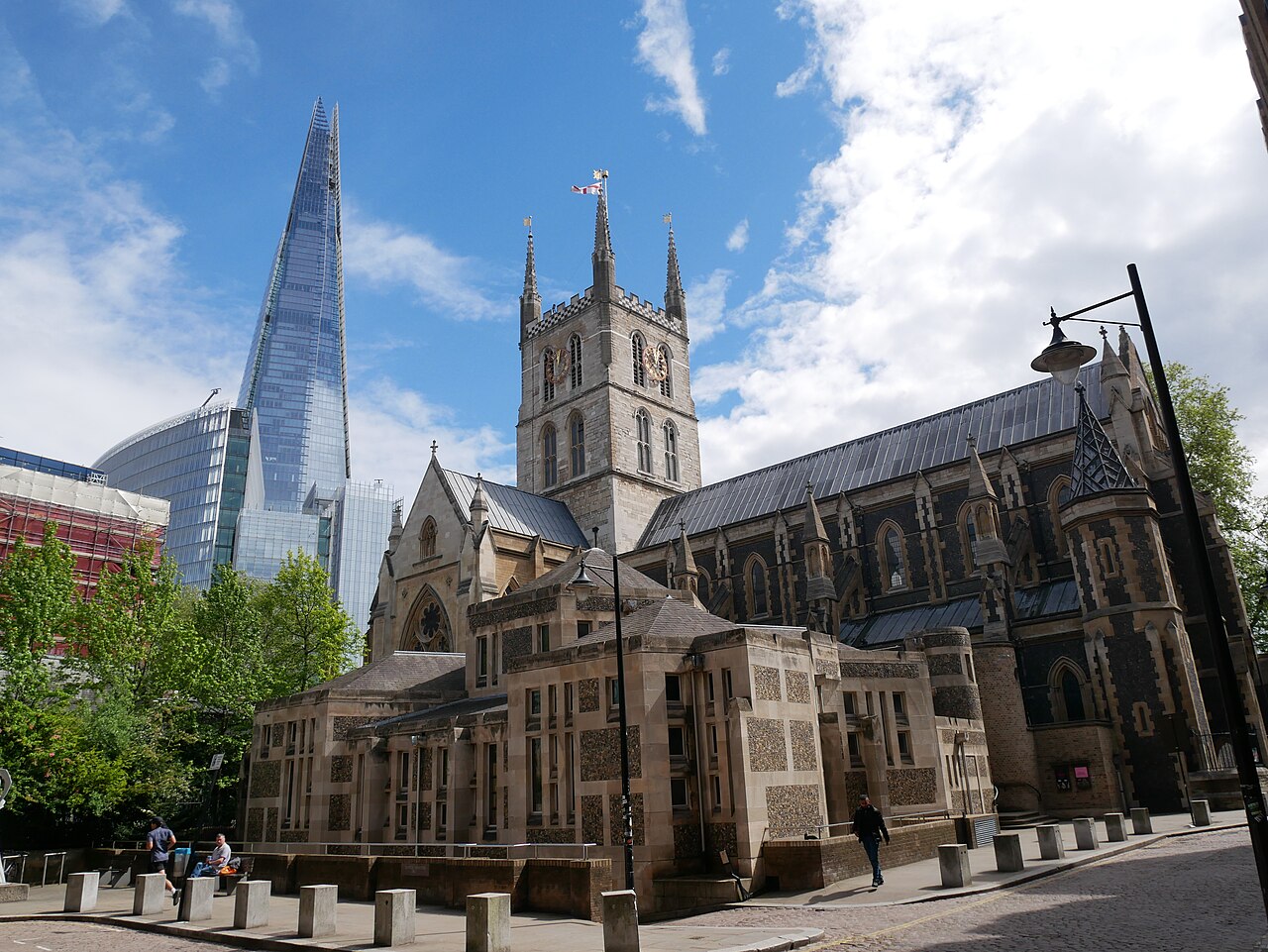
Southwark Cathedral stands beside the Thames in the London Borough of Southwark, a short walk from London Bridge. It is the mother church of the Diocese of Southwark and has served worshippers for more than a thousand years. The present building preserves the Gothic form created between 1220 and 1420, though the nave was rebuilt in the late 19th century. Before that it was the Augustinian priory of St Mary Overie, founded in 1106 on the site of an earlier collegiate church. The priory took its name from the Virgin Mary and the old description ‘over the river’. Parts of the 12th century survive, but the cruciform plan with aisled nave, crossing tower and Lady chapel dates from the 13th and 14th centuries. The cathedral holds stories of poets, playwrights and bishops. John Gower, the 14th-century poet, lived in the precinct and is buried within the church under a colourful memorial. William Shakespeare’s brother Edmund was laid to rest here in 1607, and a stone now marks the spot in the choir paving. John Harvard, who gave his name to Harvard University, was baptised in the church in 1607 and is commemorated by the Harvard Chapel in the north transept. The retrochoir witnessed the heresy trials of six clergymen in 1555, including John Hooper, former Bishop of Gloucester. A large stained glass window portrays Shakespeare with scenes from his plays, and the cathedral instituted a festival in the 1920s to honour its Elizabethan links. Inside, the nave leads to the crossing and transepts, where carved bosses from the old wooden vaults are preserved. The Lady chapel, once the Bishop’s chapel, contains the tomb of Lancelot Andrewes, a 17th-century bishop. The east end holds the retrochoir with its four chapels, two opening from the choir and two from the aisles. Beyond the choir the lower retrochoir once served as the Lady chapel. The cathedral’s walls carry memorials to dramatists John Fletcher and Philip Massinger, who lie buried here, and to Edward Alleyn, an Elizabethan actor and benefactor. Outside, the remains of Winchester Palace’s refectory wall stand in Clink Street, a short walk away.
Opening hours and admission prices change with the season and are therefore not part of this text. Current details from the operator
Discover more in this region
Themes around England
All themes in England →
Nearby
- Romano-British bath house and medieval remains at 11-15 Borough High Street89 m
- Winchester Palace124 m
- London Bridge tube station114 m
- Guys Mini Museum172 m
- Romano-Celtic temple at The Place, Southwark157 m
- The Place, Southwark157 m
QR-Code