Għar DalamBirżebbuġaGħar Dalam is a cave near Birżebbuġa in Malta’s southern region. The cave is 144 metres long and formed as a phreatic tube, a type of underground water channel. It contains animal bones from the Pleistocene and Holocene epochs, including dwarf elephants, hippopotamuses, giant swans, deer and bears. The cave gave its… číst dálOtevřít cíl
Rotunda v MostěMostaThe Rotunda of Mosta is a Roman Catholic parish church and basilica in Mosta, Malta. It stands on the site of an earlier Renaissance church built in the 17th century. Designed by Giorgio Grognet de Vassé in the 19th century, the church follows neoclassical styles inspired by the Pantheon in Rome. Its most striking… číst dálOtevřít cíl
San Anton PalaceAttardSan Anton Palace stands in Attard, a village in Malta’s northern region. Built early in the 17th century as a country villa for Antoine de Paule, a knight of the Order of St John, it became a palace when he became Grand Master in 1623. Later it served as home to other Grand Masters, then to British civil commissioners… číst dálOtevřít cíl
Victoria LinesNördliche RegionThe Victoria Lines stretch for twelve kilometres across Malta, cutting the island in two. They follow the Great Fault, a natural escarpment that once marked the boundary between the Order of Saint John’s modest forces and the open north. From Madliena in the east to the edges of Rabat in the west, the line passes near… číst dálOtevřít cíl
Borġ in-NadurBirżebbuġaBorġ in-Nadur is an archaeological site on open fields above St George’s Bay, near Birżebbuġa in Malta’s southern region. The remains sit on a low hill that overlooks the bay and the surrounding countryside. A Tarxien-phase megalithic temple from the Late Neolithic period forms the core of the site. Nearby lie the… číst dálOtevřít cíl
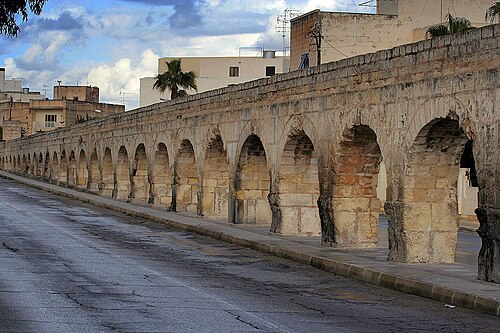
Wignacourt-AquäduktAttardThe Wignacourt Aqueduct is a 17th-century stone watercourse that once carried fresh water from springs near Dingli and Rabat to the capital Valletta. It stretches across the northern region of Malta, passing through several towns and villages. The aqueduct uses a mix of underground pipes and elevated stone arches to… číst dálOtevřít cíl
Qalet Marku-TurmNaxxarSaint Mark’s Tower stands on a rocky point called Qrejten in Baħar iċ-Ċagħaq, on Malta’s north coast. It was built in 1658 as one of the De Redin towers, a chain of small watchtowers meant to guard against pirates. The tower replaced an older medieval watch post that once stood on the same site. From its roof turret… číst dálOtevřít cíl
Victor-Tedesco-StadionĦamrunThe Victor Tedesco Stadium stands in Hamrun, a town in Malta’s southern region. Built in 1996, it has served as the home ground for Ħamrun Spartans football club. The stadium hosts matches across Malta’s top three football divisions. It also supports the club’s youth and senior teams with training sessions. Facilities… číst dálOtevřít cíl
Santa Marija ta’ Bir MiftuħGudjaSanta Marija ta’ Bir Miftuħ is a small medieval chapel on the edge of Gudja in Malta’s southern countryside. Built in the early 15th century, probably around 1430, it once served a wide rural area stretching from Birżebbuġa to Ħal Tarxien. The chapel stands alone in open fields, its simple rectangular shape still… číst dálOtevřít cíl
St Thomas TowerMarsaskalaSaint Thomas Tower stands on the headland of il-Ħamrija above Marsaskala Creek in southern Malta. Built in 1614 as the third of six Wignacourt towers, it was designed to stop enemy landings in the sheltered bays nearby. The tower’s thick walls and four corner bastions rise from a rock-hewn ditch, giving it a… číst dálOtevřít cíl
 Obrázek: Jean-Christophe BENOIST · CC BY 2.5